


March 17th, 2025
Guest Contributor: Usman Ishaq
Sometimes, you just want to kick back with a deck of cards and have some fun without needing an opponent. That’s where single-player card games come in! Whether you’re looking for a game to challenge your mind, help you relax, or simply pass the time, there’s a solo card game out there for you.
Single-player card games (also called patience games) have been around for centuries. Some rely purely on strategy and logic, while others incorporate a bit of luck. Many of them can be played with a standard deck of 52 cards, and thanks to modern technology, many classic card games are available online with interactive features, smooth designs, and easy-to-follow instructions.
Today, we’ll explore 10 of the best single player card games, diving deep into how they’re played, why they’re fun, and what makes them unique. Some are timeless classics (like Klondike and Spider Solitaire), while others are hidden gems that you might not have heard of before.
Let’s shuffle up and get started!
If you've ever played "Solitaire" on a computer, chances are it was Klondike Solitaire. This is the most well-known and widely played single player card game in the world. It's a mix of skill, patience, and a little bit of luck, making it perfect for both beginners and experienced players.
Use a standard 52-card deck (no Jokers).
Deal seven columns (also called tableau piles), with each column increasing in size. The first column gets one card, the second gets two, the third gets three, and so on.
The top card of each column is face-up; the rest are face-down.
The rest of the cards form the stockpile, which you draw from when no other moves are available.
The goal is to move all the cards into four foundation piles, arranged by suit (hearts, diamonds, clubs, spades) from Ace to King.
You can move cards between tableau piles in descending order (King → Queen → Jack, etc.), alternating red and black suits.
If you uncover an Ace, it goes to the foundation pile.
Kings (and only Kings) can be moved to an empty tableau space.
If you can’t make a move, you can draw cards from the stockpile one at a time.
It’s beginner-friendly – Easy to learn but offers depth for skilled players.
It’s available everywhere – Play it online, on your phone, or with a real deck.
It’s satisfying to complete – Nothing feels better than getting all four foundation piles filled up.

If Klondike is the king of Solitaire, Spider Solitaire is its more complex and strategic cousin. This game requires two decks of cards and is one of the most challenging patience games out there.
Uses two full decks (104 cards).
Cards are dealt into 10 columns, with the first four containing six cards and the rest containing five.
Only the top card of each column is face-up.
The goal is to build descending sequences from King to Ace within a single suit.
You can only move a group of cards if they are all in the same suit and in order.
When a full sequence (King through Ace) is completed, it disappears from the board.
If no moves are available, draw from the stockpile, which deals one new card to each column.
You win by clearing all cards from the board.
Different difficulty levels – Play with one suit (easy), two suits (medium), or four suits (hard).
Great for strategic thinkers – Every move counts, and planning ahead is key.
Highly rewarding – Completing a game gives you a real sense of accomplishment.

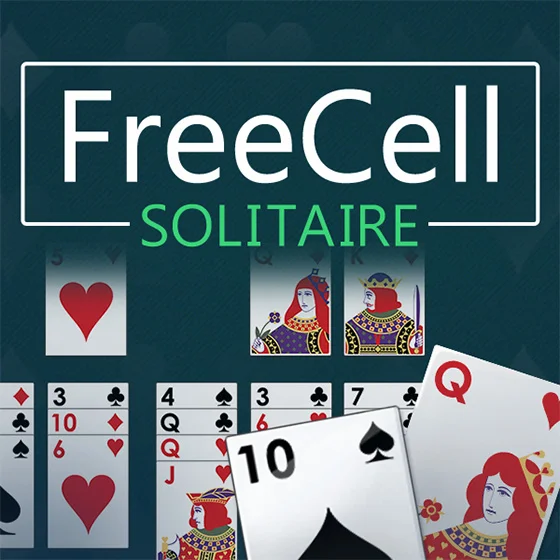
Unlike most Solitaire games, FreeCell doesn’t rely on luck. Every game is winnable if you think ahead and make the right moves, making it perfect for players who love strategy and logic puzzles.
Use a standard 52-card deck.
All cards are dealt face-up into eight tableau columns.
The goal is to move all cards into four foundation piles (one per suit), arranged from Ace to King.
You can only move one card at a time, but you have four "free cells" where you can temporarily store cards to help reorganize the board.
Empty tableau columns can be filled with any card.
Winning requires careful planning, you’ll need to think ahead to avoid getting stuck.
No luck required – If you lose, it’s because of your decisions, not bad luck.
A great brain exercise – It improves problem-solving and memory skills.
Endless replayability – Every game is a new challenge.
Pyramid Solitaire is a fast-paced, simple-to-learn card game that challenges your pattern recognition and basic math skills.
Use a standard 52-card deck.
Arrange the cards into a pyramid shape, with one card at the top, two below it, then three, and so on, until you have seven rows.
The remaining deck is your draw pile.
The goal is to remove pairs of cards that add up to 13.
Kings are worth 13, so they can be removed immediately.
If no moves are available, draw from the stockpile.
The game is won when all cards are removed.
Quick and easy to learn – Great for beginners.
Perfect for short game sessions – A typical game lasts just 5-10 minutes.
A fun alternative to traditional Solitaire.

TriPeaks Solitaire is one of the fastest-moving Solitaire variations, offering a mix of strategy and quick thinking.
Uses a standard 52-card deck.
The tableau consists of three pyramid-like peaks with overlapping cards.
The goal is to remove cards by selecting the next card one higher or one lower than the top card on the discard pile.
Quick and exciting gameplay.
Easy to learn but keeps you thinking.
Great for players who enjoy fast-paced card games.

If you’ve mastered Spider Solitaire and are looking for something more challenging, Scorpion Solitaire is the game for you. It shares similarities with Spider Solitaire but introduces a unique set of rules that require a more strategic approach.
How to Set Up Scorpion Solitaire
Uses a standard 52-card deck (no Jokers).
Deal 49 cards into seven columns, with the first four columns containing three face-down cards followed by four face-up cards. The remaining three columns contain seven face-up cards each.
The remaining three cards stay in a stockpile.
Gameplay and Strategy
The goal is to arrange cards in descending order (King to Ace) within the same suit.
Unlike Spider Solitaire, cards remain face-up for most of the game, meaning you see more possibilities at all times.
You can move groups of cards freely, even if they are not in perfect order—this creates more flexibility but also requires more planning.
The three leftover cards in the stockpile can be placed onto the first three columns at any time to help reposition sequences.
You win the game when all cards are arranged into four complete sequences of King to Ace within their suits.
Why You Should Play Scorpion Solitaire
More challenging than Spider Solitaire – Requires advanced planning and risk assessment.
Fast-paced and engaging – Unlike Spider, Scorpion Solitaire moves quicker due to fewer hidden cards.
A rewarding challenge – Completing a game feels like a real achievement.
Accordion is a lesser-known but highly strategic single-player card game. The name comes from how the cards stack and shrink together, much like an accordion folding. It requires careful observation and planning to create large merged stacks.
How to Set Up Accordion
Uses a standard 52-card deck (Jokers removed).
Shuffle and deal all 52 cards face-up in a single row.
Gameplay and Strategy
The goal is to compress all the cards into a single pile by stacking cards according to these two rules:
This creates a shifting, puzzle-like challenge where the positioning of cards greatly affects your chances of winning.
If you can consolidate all the cards into one pile, you win.
Why Accordion is Worth Playing
A unique challenge – Unlike traditional Solitaire, this game is all about movement and positioning.
No setup needed – Just shuffle, deal, and play!
Great for strategic thinkers – Requires foresight and planning.
Forty Thieves is a challenging but rewarding Solitaire variation that uses two decks of cards. It requires patience, skill, and a good strategy, making it ideal for experienced card game players who love a challenge.
Uses two full 52-card decks (104 cards total).
Deal 40 cards into 10 tableau columns, with four cards in each column, all face-up.
The remaining cards become the stockpile.
The goal is to build eight foundation piles (one for each suit), from Ace to King.
You can only move one card at a time, making the game much harder than Klondike or Spider.
Unlike other Solitaire games, you cannot move entire stacks of cards—only single cards can be moved between columns.
When no moves are available, draw from the stockpile, but be careful—there’s only one pass through the deck!
You win the game by successfully transferring all cards to the eight foundation piles.
Highly strategic – Every move must be carefully planned.
Uses two decks – More cards, more complexity, more fun!
One of the toughest patience games – Perfect for Solitaire pros.

Yukon Solitaire looks similar to Klondike at first, but it removes the need for a stockpile, allowing for more freedom in movement. If you love Klondike but want a more strategy-based version, Yukon is a fantastic alternative.
How to Set Up Yukon Solitaire
Uses a standard 52-card deck.
Like Klondike, deal seven columns, but every card is placed at the start (no stockpile).
Only the top card in each column starts face-up, while the others are face-down.
Gameplay and Strategy
Move cards between tableau piles in descending order and alternating colors, just like Klondike.
Unlike Klondike, you can move entire sequences of cards even if they aren’t in perfect order.
You must work to free hidden cards, uncovering aces and lower-ranked cards to start building foundation piles.
The game is won when all cards are sorted into the four foundation piles from Ace to King.
Why You Should Play Yukon Solitaire
More strategic than Klondike – Allows greater freedom of movement.
No stockpile – Forces you to rely purely on your planning skills.
A perfect mix of challenge and fun.
Beleaguered Castle is a lesser-known but highly strategic single-player card game. Unlike most Solitaire variations, all cards are visible from the start, meaning there’s no luck involved only skill.
How to Set Up Beleaguered Castle:
Uses a standard 52-card deck.
Deal all 52 cards into eight tableau columns with six cards each.
Place four Aces in the center, which will serve as the foundation piles.
Gameplay and Strategy
The goal is to build four foundation piles from Ace to King.
You can move only the top card of each column, making every move critical.
Since all cards are face-up, you must think ahead to avoid blocking necessary moves.
Why Beleaguered Castle is Worth Playing
No luck, all strategy – Every move is purely logical.
A great mental workout – Requires deep thinking and patience.
Simple setup, big challenge.
Single-player card games are a fantastic way to have fun, relax, and sharpen your mind. Whether you enjoy strategy-based games like FreeCell and Beleaguered Castle or prefer faster-paced games like Pyramid and TriPeaks, there’s a solo card game that’s perfect for you.
Have a favorite solo card game? Share it in the comments!
Looking for free online versions of all your favorite Soliatire games? Check out Arkadium’s curated collection for endless entertainment!
ExploreCategory: Card Games

